Sit Down, Jenny: 5 Minutes at 5
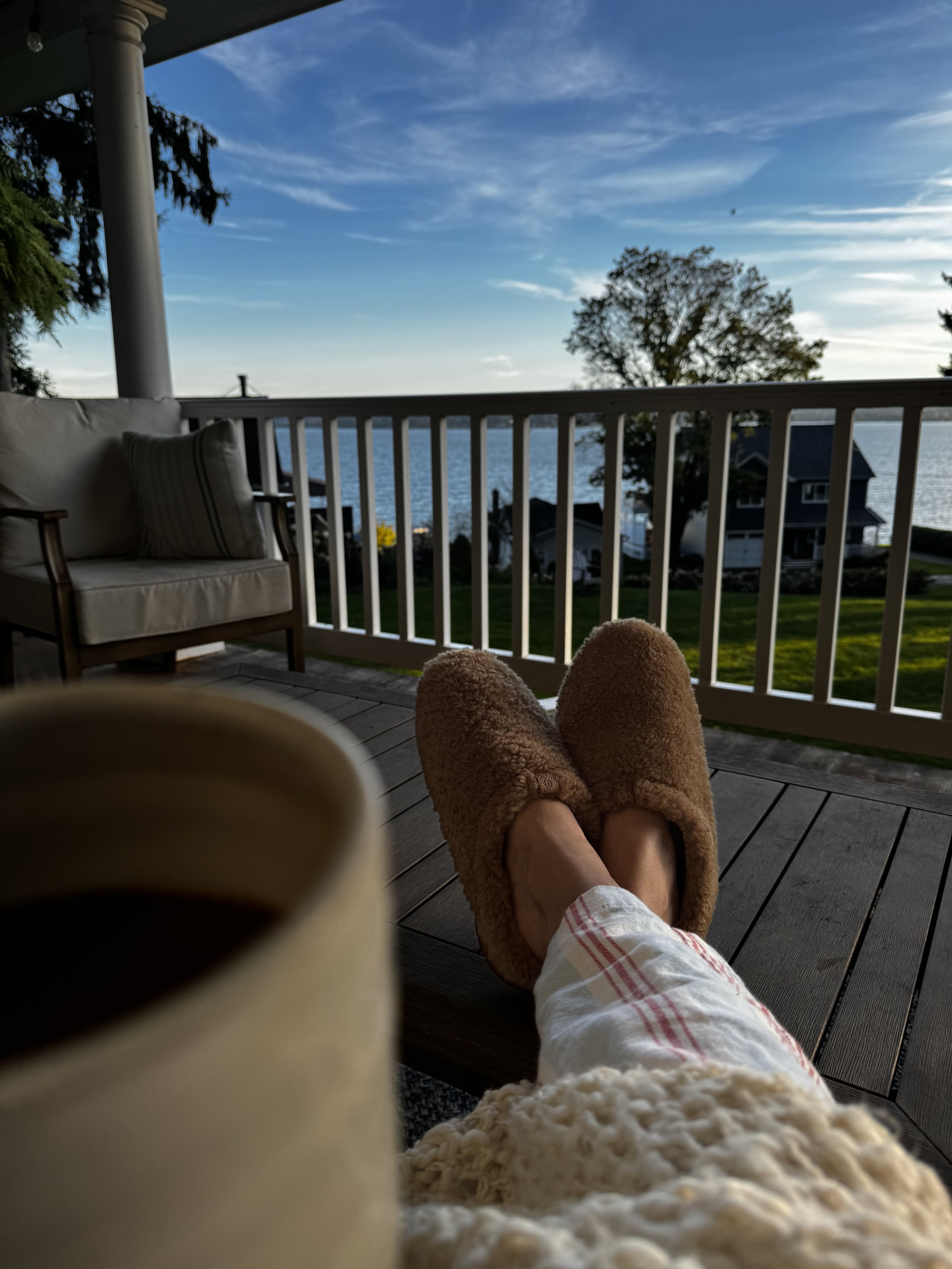
Sit Down, Jenny: 5 Minutes at 5
Join me for five minutes of quiet at 5 p.m., every day for 15 days.
It took me more than 30 years to see what fall does to me.
It hit me on the drive home this past weekend, in the rain, exhausted, with hours still to go.
I'd gone back to Boston for just 40 hours. I coxed a boat at 5 a.m., saw 10 clients in person, checked on my house (still a construction zone), slept at a friend's, celebrated my almost-27-year-old's birthday with games in the North End, and taught a live class from a client's house Saturday morning. Then I drove eight hours home to Chautauqua through a storm.
Somewhere on that drive, I realized I was doing it again- overdoing it all as I jump back into fall.
The fall pattern
Every fall, I tell myself I'm excited for the season. I put out the pumpkins and add cinnamon to everything. Then I pack my calendar so full I can't enjoy any of it. More clients. Yes to everything. I fall into bed too tired to carve a pumpkin, let alone light it.
Busy feels productive. Busy feels safe. And by the end of October, surprise, surprise, I'm feeling worn out.
That isn't bad luck. It's my body doing exactly what I've trained it to do.
The season my body keeps score
Fall is when everything I've been carrying catches up with me. My body tells a different story than the one I've been telling myself.
My dad had a heart attack last October. My family struggles in the fall, too. There's history there: things we held on to too long, things that stayed in our hearts and minds as the season turned. We've worked hard these past several years to face what triggers us. That work continues, and I'm learning to notice when fall brings it to the surface.
Here's what I know as a coach: when we stay busy and braced, the body stays in its stress state. That's the sympathetic nervous system, fight or flight. It's built for short bursts: a 5 a.m. race start, an eight-hour drive in a storm. It isn't built to run all season.
When it does run all season, it pays for it. Stress hormones stay high. Sleep gets lighter. Digestion slows. The immune system gets pushed to the back of the line. So of course I get sick by Halloween.
Do you have a season like that?
What quiet does for you
The counterweight is your parasympathetic nervous system, the "rest and digest" side. Its main pathway is the vagus nerve, which runs from your brainstem down through your heart, lungs, and gut.
When you sit quietly and slow your breathing, especially when you breathe out longer than you breathe in, you signal that nerve. Your body responds:
Your heart rate slows, and your heart rate variability (a key marker of resilience) can improve with regular practice.
Your breathing deepens, and your blood pressure can ease down.
Digestion turns back on. Blood flow and energy return to your gut.
Stress hormones settle over time instead of staying high all day.
Your immune system gets room to work.
Sleep comes easier, because your body has practiced shifting down before bedtime.
None of this takes an hour. It takes a signal, sent regularly, so that downshifting becomes a skill your body knows.
That's why I'm not starting with a retreat. I'm starting with five minutes.
Do you know how hard it is for me to sit still?
A church pew? No problem. A summer symphony in the Amp, Mahler, Beethoven, Bach? I can sit still. My yard under the stars? As long as my neck allows.
But SITTING STILL FOR 5 EXTRA MINUTES ON MY OWN PORCH, with no program, no one needing me, and no final note?
That is a challenge.
Why the porch, and why 5 p.m.
Sitting on my porch means changing a habit I've practiced for decades. It's also how I start with clients: we pick one familiar part of the day they're ready to change.
I ask about everything. When do you wake up? How do you sleep? When do you eat and take your medications? When do you get crabby in the afternoon?
Then we find one place where a small change feels possible, maybe 6 a.m., 4 p.m., or 9 p.m. We bend that habit a little and grow something good in its place. One minute. Then two. Then five. Over time, that small choice carries into the rest of the day.
For me, that place is 5 p.m. It's the hinge of my day. Work is winding down, dinner hasn't started, and it's exactly when I usually grab my phone, add one more thing, or push through. It's also when my nervous system most needs a signal that the day's demands are over.
So I'm taking my own advice. Five minutes. Five o'clock. Fifteen days.
Join me in quiet: the 5 at 5 challenge
Starting today, October 1, and running through October 15, every day at 5 p.m., I'm going to sit still for five minutes. I'd love for you to sit with me.
Here's all it takes:
Set an alarm for 4:55. Call it "5 at 5."
Find your spot. A porch, a car, a kitchen chair, a bench outside your office.
Put your phone out of reach. No music, no podcast, no journal.
Sit with your feet on the floor and breathe. In through your nose for four counts, out for six. Let your breathing slow down.
Notice what comes up. Don't fix it. Just let it settle.
That's it. Five minutes. If five feels like too much, start with one. That still counts.
We'll be in different places, but we'll be quiet together at the same time every day. That matters more than you'd think.
Who's with me?
What's one small place in your day where you'd like to make a change? Maybe it's a habit you've carried for years. Maybe you already know exactly what it is.
Ask yourself: "How's that working for me today?"
Then reply, comment, or message me "I'm in" so I know you're sitting with me at 5. And if you know me well, hold me accountable. Next time you see me, ask me how my five minutes went.
It might be the hardest workout either of us does this fall.
Let's give ourselves a quieter, stronger October.
Sit down with me. See you at 5.
— Jenny